Building a Proactive Brand Reputation Strategy for 2026
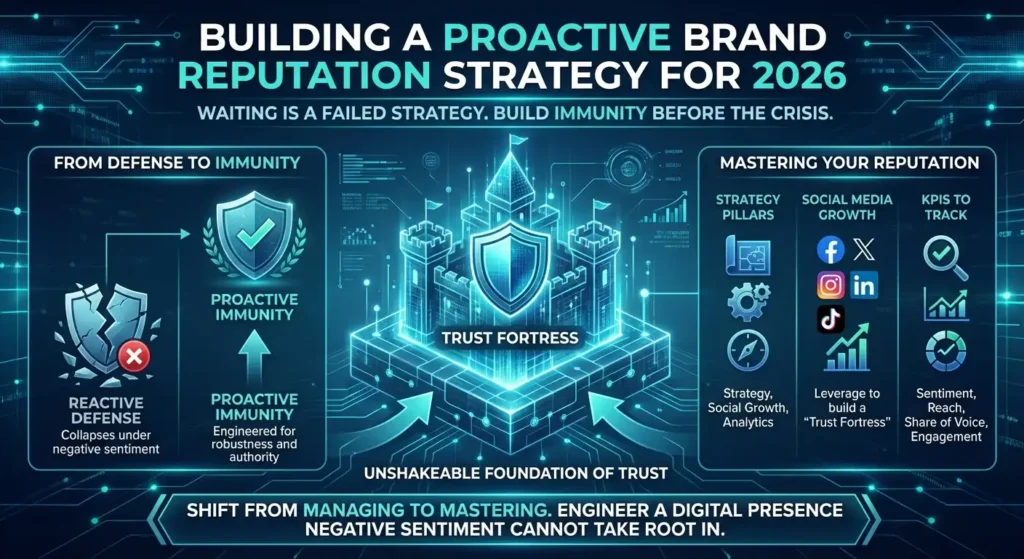
In 2026, waiting for a crisis to strike is a failed strategy. In the hyper-connected digital age, defense is not enough; you must build immunity before you need it.
A proactive Brand Reputation Strategy is no longer just about “being nice” to customers – it is about engineering a digital presence so robust and authoritative that negative sentiment cannot take root.
It is the difference between a brand that collapses under a single bad review and one that shrugs it off because its foundation of trust is unshakeable.
This guide outlines how to shift from managing your reputation to mastering it. We will cover the core pillars of strategy, how to leverage Social Media Growth to build a “trust fortress,” and the specific KPIs you need to track to stay ahead.
Table of Contents
What is Brand Reputation Strategy? (And Why It Matters)
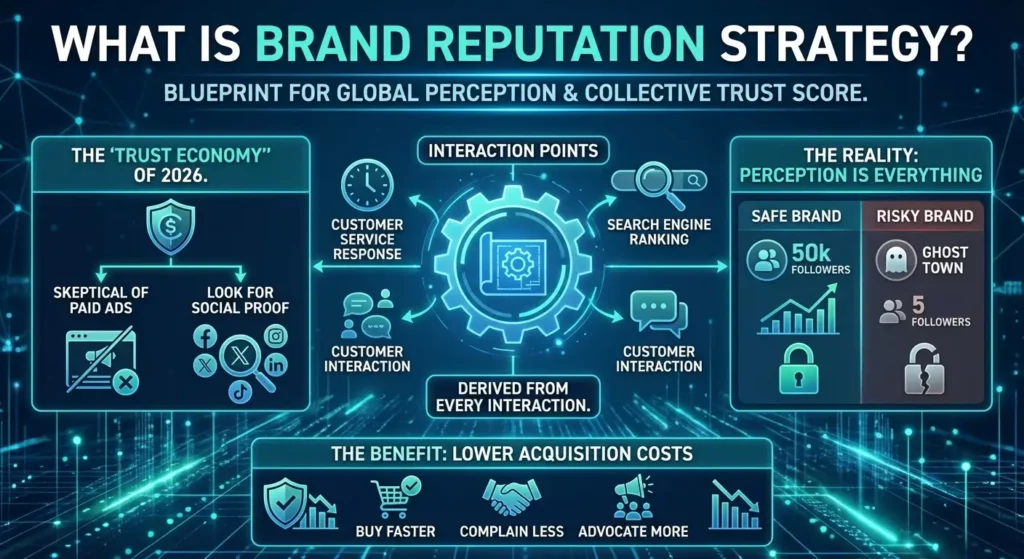
Brand Reputation Strategy is the blueprint for how the world perceives your business. It is the “collective trust score” derived from every interaction a customer has with you – from your customer service response times to your search engine ranking.
In the past, reputation was vague. Today, it is quantifiable. It lives in star ratings, follower counts, and comment sections.
The “Trust Economy” of 2026
We have entered a “Trust Economy.” Consumers are increasingly skeptical of paid ads and corporate messaging. Instead, they look for Social Proof.
- The Reality: A brand with 50,000 followers and active engagement is perceived as “safe.” A brand with a ghost town profile is perceived as “risky.”
- The Benefit: A strong brand reputation management plan lowers your customer acquisition costs. When people trust you, they buy faster, complain less, and advocate for you more.
The 5 Pillars of Brand Strategy
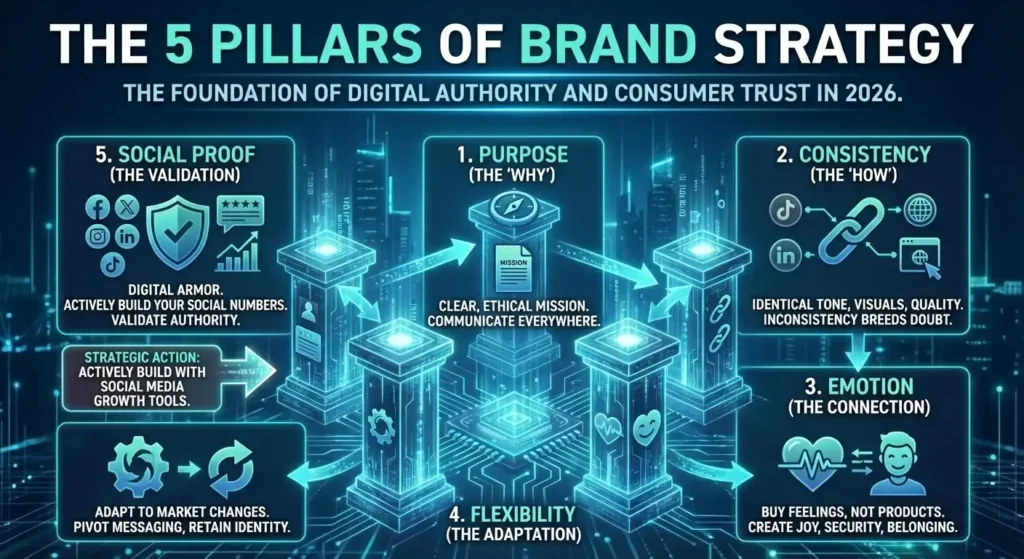
To build a reputation that lasts, you cannot rely on guesswork. You need a structure. If you are asking, “What are the 5 pillars of brand strategy?”, they are: Purpose, Consistency, Emotion, Flexibility, and Social Proof.
1. Purpose (The “Why”)
Your reputation starts with your mission. Consumers in 2026 align with brands that stand for something. Your purpose must be clear, ethical, and communicated across every channel.
2. Consistency (The “How”)
A fragmented brand is a mistrusted brand. Whether a customer meets you on TikTok, LinkedIn, or your website, the tone, visuals, and service quality must be identical. Inconsistency breeds doubt.
3. Emotion (The Connection)
People do not buy products; they buy feelings. Your strategy must focus on how you make customers feel. Positive emotional connections (joy, security, belonging) are the strongest defense against future PR issues.
4. Flexibility (The Adaptation)
The market changes fast. A rigid strategy breaks; a flexible one adapts. Your brand must be ready to pivot its messaging based on cultural shifts without losing its core identity.
5. Social Proof (The Validation)
This is the pillar most businesses neglect until it is too late. Social Proof is your digital armor. It includes your reviews, your follower count, and your engagement rates.
- Strategic Action: You cannot wait for this to happen organically. You must actively build it. Using Social Media Growth tools to ensure your social numbers reflect your market leadership is not vanity – it is a critical signal of authority that validates your brand to new visitors.
7 Proven Strategies to Build an Unshakeable Reputation
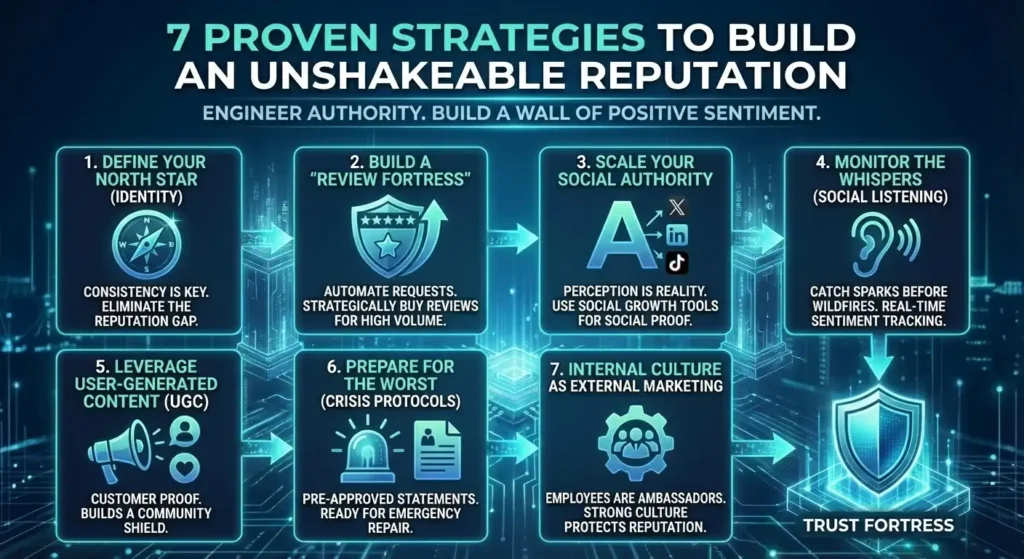
To improve brand reputation in 2026, you cannot be passive. You must build a wall of positive sentiment so high that occasional negative feedback is invisible. Here are seven strategies to engineer that authority.
1. Define Your North Star (Identity)
Before you can sell your reputation, you must define it. Inconsistency is the silent killer of trust.
If your website says “Premium Service” but your Instagram comments are filled with ignored complaints, you have a reputation gap. Ensure your tone, visual identity, and core values are identical across every platform.
2. Build a “Review Fortress”
Do not wait for reviews to happen by accident; satisfied customers are often quiet, while unhappy ones are loud. You must aggressively generate positive feedback to create a “fortress” around your rating.
- The Tactic: Automate review requests via email or SMS.
- The Accelerator: If your volume is low, you are vulnerable. A single 1-star review can ruin a 5.0 rating if you only have three reviews. To prevent this, you can strategically buy Google reviews to build a high-volume baseline. A business with 500+ reviews is statistically immune to the impact of a few bad comments.
3. Scale Your Social Authority
In the digital world, perception is reality. When a potential partner or customer researches you, they look at your follower count as a proxy for your market share.
- The Strategy: A proactive strategy requires looking like a leader now, not ten years from now. Use Social Media Growth tools to ensure your follower counts and engagement metrics match your ambitions. High social numbers signal “Social Proof,” validating to new visitors that you are an established authority worth trusting.
4. Monitor the Whispers (Social Listening)
Most crises start as a whisper – a tweet, a Reddit thread, or a side comment. Social Listening allows you to catch these sparks before they become wildfires.
Looking For Google Reviews? Claim your Discount Below
 8,492 people used this service in the past 7 days

Tools like Brand24 or Mention help you track sentiment in real-time. According to HubSpot, brands that engage in social listening respond to crises 5x faster than those that don’t.
5. Leverage User-Generated Content (UGC)
Your brand saying “We are great” is marketing; your customer saying “They are great” is proof. Actively encourage customers to share their experiences.
Sharing UGC builds a community shield – when you highlight your customers, they become defenders of your brand during tough times.
6. Prepare for the Worst (Crisis Protocols)
Even the best strategy cannot prevent every disaster. The difference between a hiccup and a headline is preparation. Have a “Crisis Protocol” ready: pre-approved statements, a designated spokesperson, and a chain of command.
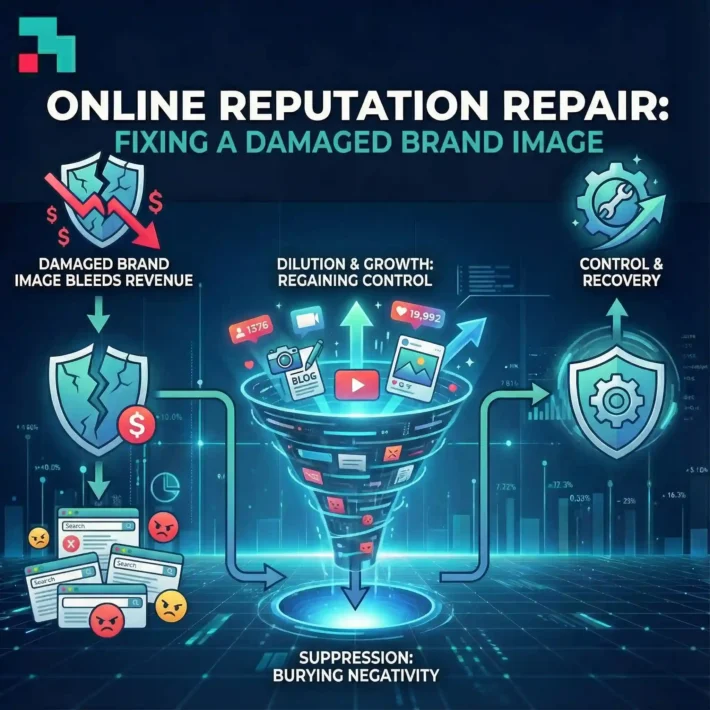
- The Contingency: If a crisis does break through your defenses, you need to switch gears immediately from “Building” to “Fixing.” (For a detailed breakdown of emergency steps, read our guide on Online Reputation Repair: 5 Steps to Fix a Damaged Brand Image).
7. Internal Culture as External Marketing
Your employees are your most powerful brand ambassadors. A toxic internal culture eventually leaks out in the form of bad service or Glassdoor reviews.
Harvard Business Review notes that companies with strong cultures see a 4x increase in revenue growth. Treat your team well, and they will protect your reputation for you.
Measuring Your Success: KPIs for Brand Reputation
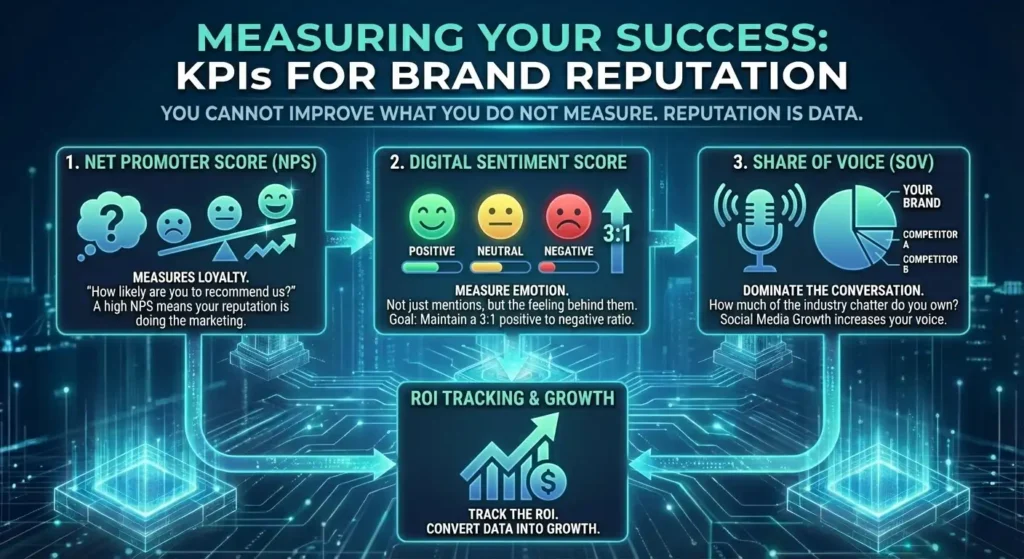
You cannot improve what you do not measure. A common mistake is treating reputation as a “vague feeling.” In 2026, it is data. To track the ROI of your strategy, you must monitor specific Key Performance Indicators (KPIs).
If you are asking, “What is KPI for brand reputation?”, focus on these three metrics:
1. Net Promoter Score (NPS)
This measures loyalty. Ask one simple question: “How likely are you to recommend us to a friend?” A high NPS means your reputation is doing the marketing for you.
2. Digital Sentiment Score
It is not enough to count mentions; you must measure the emotion behind them. Tools like Brandwatch or Talkwalker assign a “Sentiment Score” (Positive, Neutral, Negative) to your online mentions. Your goal is to maintain a ratio of 3:1 positive to negative.
3. Share of Voice (SOV)
How much of the industry conversation do you own? If people are talking about “running shoes,” are they talking about Nike or you? Social Media Growth directly impacts this KPI – the larger your audience, the louder your voice, and the more likely you are to dominate the conversation over competitors.
Conclusion
Reputation is an asset you build, not just something you protect. In 2026, the brands that win will be the ones that stop playing defense and start playing offense.
By defining your purpose, monitoring your sentiment, and aggressively building your Social Media Growth, you create a “trust immunity” that protects your revenue for the long term.
Do not wait for a crisis to define you. Start building your fortress today.
(For a complete roadmap on managing your digital presence, read our Comprehensive Guide to Social Media Reputation Management).
Frequently Asked Questions
What are the 5 pillars of brand strategy?
They are Purpose, Consistency, Emotion, Flexibility, and Social Proof. A successful strategy aligns these five elements: knowing your mission, delivering it consistently, connecting emotionally, adapting to change, and validating your worth through strong social signals (reviews and followers).
Who is responsible for brand reputation strategy?
Everyone, but it must be led from the top. While the CMO (Chief Marketing Officer) typically designs the strategy, Customer Support executes it daily, and HR ensures the internal culture supports it. In 2026, reputation is a cross-departmental responsibility.
What is brand reputation with an example?
Brand reputation is the collective public perception of a company’s reliability and quality.
- Example: Apple has a reputation for innovation and privacy. Even if a new iPhone has a minor bug, customers trust the brand enough to overlook it.
- Contrast: A generic electronics brand with no reputation might face a boycott for the exact same bug because they lack that “trust bank.”
What is KPI for brand reputation?
The most critical KPIs are Net Promoter Score (NPS) (customer loyalty), Sentiment Analysis (the emotional tone of online mentions), and Share of Voice (your visibility compared to competitors). Tracking these allows you to see if your reputation is an asset or a liability.