The Comprehensive Guide to Social Media Reputation Management
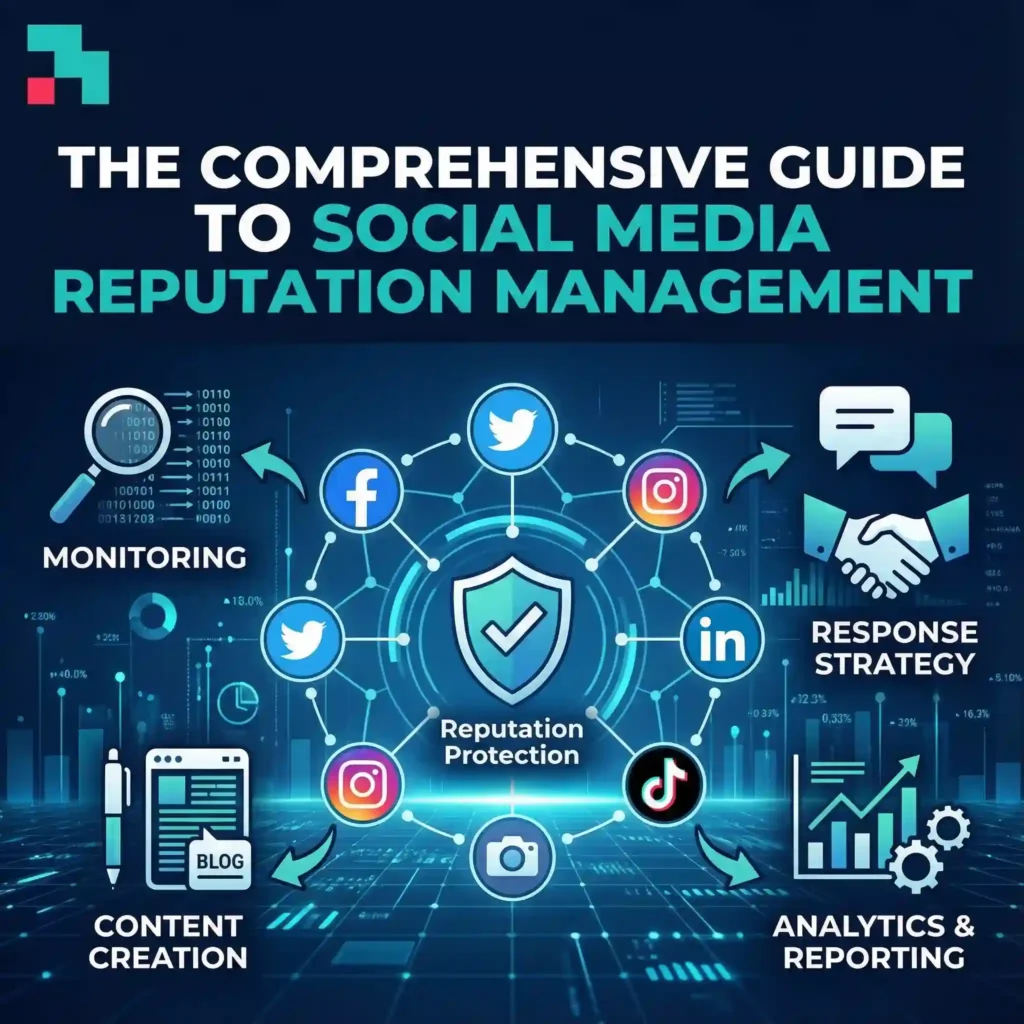
In the digital economy, Social Media Reputation Management is the defining factor between a thriving business and a failing one. It is no longer enough to simply exist online; a single viral post or a neglected comment section can impact your revenue overnight.
This guide moves beyond simple damage control. We will explore how to monitor your digital footprint and use strategic social media growth to build an authority so strong that it immunizes your brand against negativity.
Table of Contents
What is Social Media Reputation Management?

At its core, social reputation management is the process of monitoring, influencing, and protecting your brand’s image across platforms like Facebook, X (Twitter), Instagram, LinkedIn, and TikTok.
However, many businesses make the mistake of thinking this is purely a defensive task. True Brand Reputation Management is a hybrid of Public Relations (PR), SEO, and growth strategy. It involves curating a digital presence that screams “trustworthiness” before a customer even reads a single review.
The Two Pillars: Defense vs. Offense
To master this, you must operate in two directions simultaneously:
- Reactive (Defense):
This involves handling negative feedback and mitigating PR disasters. This is what most people think of – cleaning up a mess.
- (For a deep dive on fixing past mistakes, read our guide on [Online Reputation Repair: 5 Steps to Fix a Damaged Brand Image]).
- Proactive (Offense):
This is where the real value lies. It involves building “social proof” by accumulating followers and high engagement. When your brand looks popular, new customers automatically trust you.
- (Learn more about planning ahead in our article: [Building a Proactive Brand Reputation Strategy for 2026]).
Why “Social Signals” Are the New Currency
Why does a verified account with 100k followers suffer less damage from a negative review than a new account with 50 followers?
The answer is Social Signals. Algorithms use engagement metrics (likes, views, shares) as proxies for trust. When you have high engagement, the algorithm assumes your content is valuable and prioritizes it over negative noise.
From a social reputation analysis perspective, high engagement numbers act as a shield, making your brand appear “too big to fail” to consumers.
The Importance of Reputation Management: Why It Can’t Wait
The importance of reputation management cannot be overstated in a market where 90% of consumers read online reviews before visiting a business. Your reputation is often the deciding factor between a conversion and a bounce.
If you ignore your social standing, you aren’t just risking bad PR; you are actively losing money. Here is why prioritizing brand reputation management is essential for revenue growth.
Trust Influences Purchase Decisions
Modern consumers are skeptical. They look for validation from their peers before they open their wallets. If they visit your Facebook or Instagram page and see a “ghost town” – few likes, no comments, and low follower counts – they instinctively perceive the business as risky or illegitimate.
Conversely, a vibrant social presence acts as a psychological green light. It signals that others have already vetted you, making the purchase decision safer and faster for the new customer.
The “Zero-Click” Judgement
We live in an attention economy. Users often make a “zero-click” judgement about your brand’s legitimacy in milliseconds, often without even clicking through to your website.
They look at two things immediately:
- Follower Count: Does this brand have an audience?
- Engagement Rate: Is the audience real?
If these numbers are low, you lose the customer before you’ve even had a chance to pitch your product. This is why many brands use social media growth strategies to ensure their “surface-level” metrics reflect the quality of their service.
Social Reputation Analysis & SEO
Your social reputation doesn’t just live on social media; it also impacts Google. Search engines increasingly use social signals to help determine authority.
When you perform a social reputation analysis, you will often find that your social profiles rank in the top 5 search results for your brand name.
If those profiles look neglected, you are sabotaging your own SEO. A strong, active social profile dominates the search results, pushing negative content off the first page.
The 4 Key Elements of Reputation Management
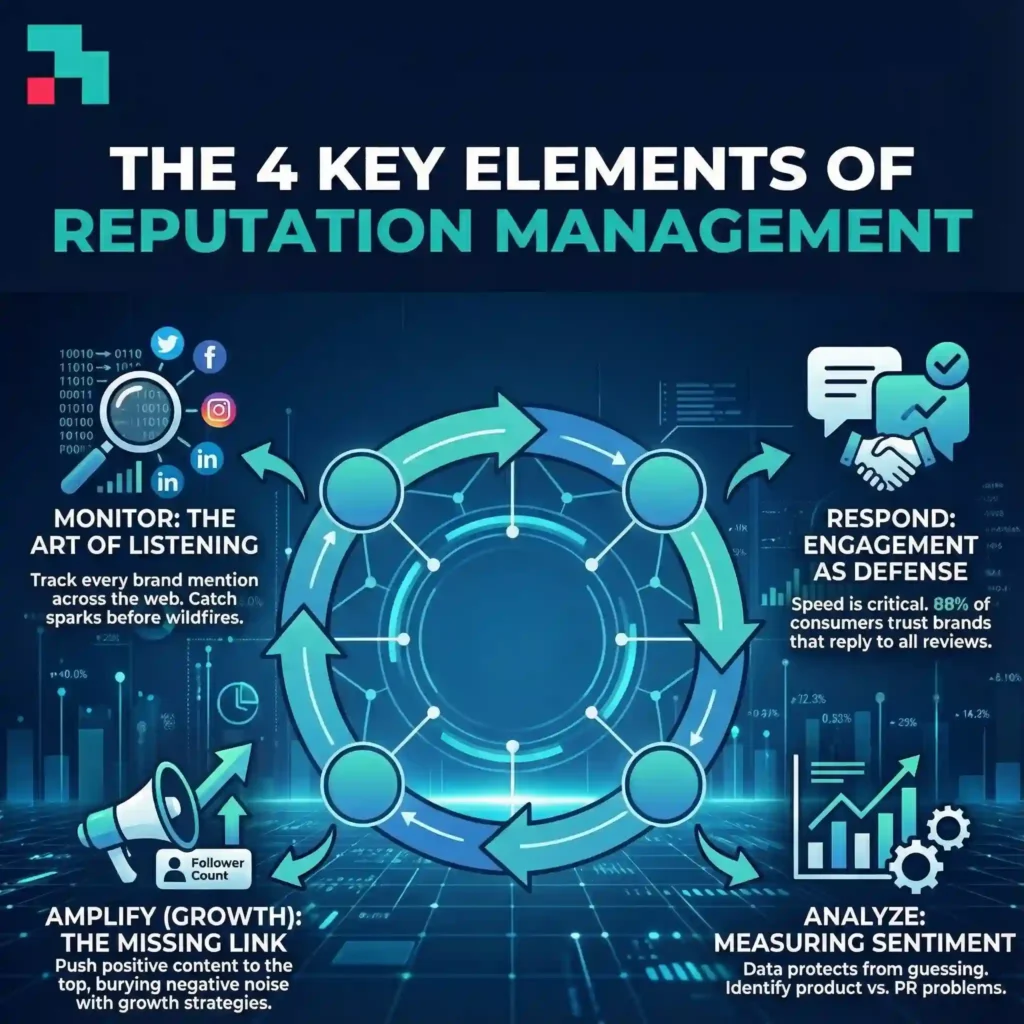
A successful reputation strategy isn’t just about deleting bad comments. It requires a cyclical process that keeps your brand safe and growing. If you are asking, “What are the four key elements of reputation management?”, they are: Monitor, Respond, Analyze, and Amplify.
1. Monitoring: The Art of Listening
You cannot fix what you don’t see. Monitoring involves tracking every mention of your brand, product, or executives across the web. Most crises start small; effective monitoring allows you to put out the spark before it becomes a wildfire.
2. Response: Engagement as Defense
How you respond to criticism defines your brand more than the criticism itself. Speed is critical here. According to Forbes, 88% of consumers are more likely to use a business that replies to all reviews, both positive and negative. Silence is often interpreted as guilt.
3. Analysis: Measuring Sentiment
Data protects you from guessing. Social reputation analysis involves looking at the sentiment behind the numbers. A ReviewTrackers study found that 94% of consumers have avoided a business because of a negative review. Analyzing these trends helps you identify if you have a product problem or just a PR problem.
4. Amplification (Growth): The Missing Link
This is the step most competitors miss. Once you have positive content, you must ensure it is seen. This is where social media growth becomes a reputation tool. By using growth strategies to increase followers and engagement on your positive posts, you signal to algorithms that this is the content that matters. This “Amplify” step is what pushes positive content to the top of search results, effectively burying the negative noise.
A 7-Step Strategy to Master Your Social Reputation
Building a bulletproof reputation doesn’t happen by accident. It requires a deliberate strategy that combines vigilance with growth.
1. Audit Your Current Digital Footprint
Before you can improve, you must know where you stand. Google your brand name in an “Incognito” window to see what a new customer sees. Look for outdated profiles or unresolved complaints. This initial audit will reveal your weakest links.
2. Set Up Always-On Social Listening
Don’t wait for a notification to tell you someone is talking about you. Set up alerts for your brand name, your competitors, and key industry terms.
Looking For Google Reviews? Claim your Discount Below
 8,492 people used this service in the past 7 days

For social media, you need dedicated listening software that catches untagged mentions, as these are often where the most honest conversations happen.
3. Establish a Response Protocol (The Dos and Don’ts)
Consistency saves time and prevents PR errors. Create a “Crisis Playbook” for your team.
- Do: Respond quickly (within 24 hours), stay professional, and offer to move complex disputes to DMs.
- Don’t: Get defensive, argue with trolls, or use copy-paste generic responses for serious issues.
4. Leverage Social Proof to Build Authority
A brand with 50 followers looks vulnerable; a brand with 50,000 looks like an industry leader. This is where social media growth becomes a strategic asset.
By boosting your follower count and engagement rates, you create a “buffer” of authority. High engagement numbers psychologically signal that your brand is trusted by the masses, making individual negative comments seem like outliers.
5. Encourage and Manage User-Generated Content (UGC)
Your happiest customers are your best marketers. Actively encourage them to share photos or stories using your product.
When you repost this User-Generated Content, you validate your brand through the voice of others. According to BrightLocal, 46% of consumers trust online reviews as much as personal recommendations.
6. Optimize Your Profiles for Search (Social SEO)
Your social profiles often rank higher than your actual website. Optimize your bio, descriptions, and posts with relevant keywords. A fully optimized LinkedIn or Instagram profile acts as a “positive shield” in search results, occupying valuable real estate on the first page of Google.
7. Analyze Sentiment and Pivot
Reputation management is not a “set it and forget it” task. Review your analytics monthly. If sentiment is dropping, ask why. Use the data to pivot your strategy before a small trend becomes a permanent reputation stain.
Crisis Management: How to Survive a Social Media Storm
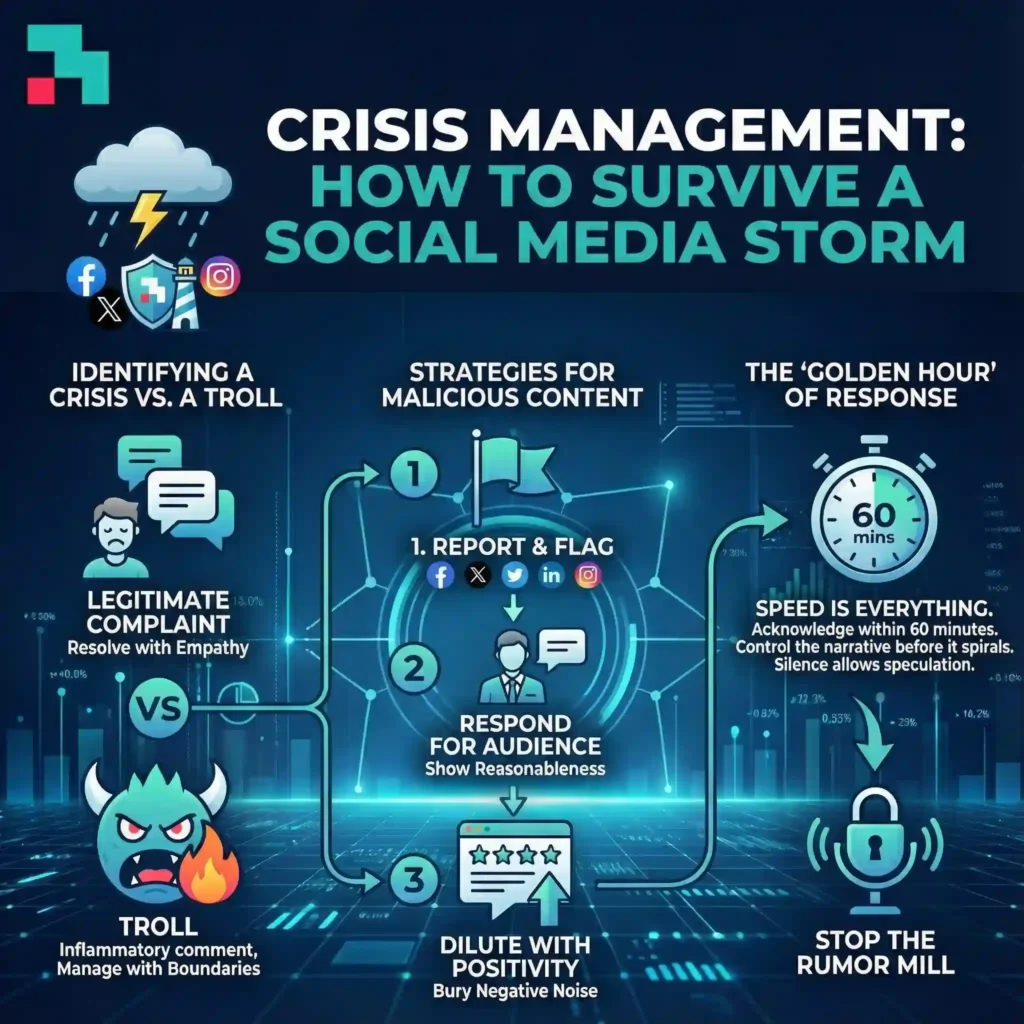
No matter how perfect your service is, you cannot please everyone. Eventually, you will face negative feedback. The difference between a minor hiccup and a full-blown PR disaster lies entirely in how you handle the situation when it arises.
Identifying a Crisis vs. a Troll
Not every negative comment constitutes a crisis. A legitimate customer complaint is an opportunity to improve.
A “troll,” however, is someone posting inflammatory content simply to provoke a reaction. You resolve customer complaints with empathy, but you manage trolls with strategic boundaries.
Strategies for Dealing with Malicious Content
Fake reviews and malicious comments are a common fear for business owners. When you encounter content that is clearly false or aimed at damaging your reputation, follow this three-step protocol:
- Report and Flag: If the review violates the platform’s terms of service (e.g., hate speech, conflict of interest, or spam), flag it immediately for removal.
- Respond for the Audience: If removal fails, reply professionally to show future customers you are reasonable. A calm “We have no record of this, please contact us” discredits the fake review without sounding defensive.
- Dilute with Positivity: If you can’t delete it, bury it. Strategies to buy Google reviews act as a defensive shield, ensuring a single 1-star rating is rendered irrelevant by a flood of fresh 5-star testimonials.
The “Golden Hour” of Response
In the world of social media, speed is everything. The “Golden Hour” refers to the first 60 minutes after a negative post goes live.
If you can acknowledge the issue within this window, you control the narrative before it spirals. Silence allows speculation to breed; a quick, transparent response stops the rumor mill in its tracks.
Top Tools for Social Media Reputation Management
Managing a reputation manually is nearly impossible. While there are dozens of software options available, most only allow you to watch what is happening. To actually control your reputation, you need a different approach.
What is the best tool for online reputation management?
The best tool is one that allows you to proactively build authority rather than just passively monitor it. Reputation Manage stands out because it focuses on growth as a defensive strategy.
While other tools simply alert you to a bad comment, our growth services act as an active “reputation engine.”
By consistently delivering real followers, likes, and engagement, we ensure your social profiles appear too authoritative to be damaged by minor negativity. In 2025, the most powerful tool is a strong offense – building a massive, engaged audience that serves as social proof.
Monitoring & Listening Tools
Once you have your growth strategy in place, you can use these software solutions to keep an ear to the ground:
- Brand24: Excellent for tracking “unmentioned” brand conversations across the web.
- Talkwalker: A powerful enterprise-level tool that offers deep sentiment analysis and visual listening (tracking your logo in images).
Management Dashboards
To handle the day-to-day posting and replying, these dashboards are industry standards:
- Hootsuite: Allows you to manage multiple social streams in one place, ensuring you never miss a reply.
- Agorapulse: Great for agencies, offering a unified inbox that helps you hit that “Golden Hour” response time easily.
Conclusion
Your reputation is an active ecosystem, not a static score. In 2025, waiting for a crisis to strike is a strategy for failure.
True Social Media Reputation Management is about immunity. It is about building a brand presence so robust and engaged that negative comments simply bounce off.
By combining vigilant monitoring with aggressive social media growth, you ensure that when a potential customer searches for you, they see a market leader – not a risky bet.
Don’t leave your reputation to chance. Start building your authority today.
Frequently Asked Questions
Should I consider hiring a professional for social media reputation management?
Yes, especially for rapid scaling or crisis recovery. Professionals use specialized tools to generate social media growth that effectively dilutes negative sentiment – something difficult to achieve manually.
How long does it take to repair a damaged online reputation?
It typically takes 3 to 6 months. While you can bury specific reviews quickly with aggressive positive engagement, rebuilding genuine trust and authority is a longer-term process.
Can I just delete my social media pages to stop negative reviews?
No, this often signals guilt. Furthermore, unofficial threads will likely appear in your absence, leaving you with no control. It is safer to keep your accounts active and use them to dominate the narrative.
Do social media mentions actually affect my Google ranking?
Indirectly, yes. High social engagement drives traffic and increases brand searches. These are powerful signals to Google that your business is authoritative, often helping your profiles rank above negative third-party sites.