How to Build a Winning Social Media Strategy from Scratch (2026 Guide)

In the rapidly evolving landscape of 2026, posting without a plan is no longer just a wasted effort – it is an active liability.
With organic reach on legacy platforms like Facebook and Instagram hovering near historic lows and competition for attention reaching a fever pitch, a random collection of posts is insufficient to grow a business. To see real Return on Investment (ROI), you need more than just content; you need a blueprint.
A winning Social Media Strategy acts as the bridge between your high-level business goals and your daily social media activity. It answers the critical questions that many businesses skip: Why are we posting? Who are we actually talking to? And how will we measure success beyond vanity metrics?
This comprehensive guide will walk you through how to create a social media strategy from the ground up. We will move beyond simple posting schedules to build a robust social media marketing plan that drives revenue, builds trust, and positions your brand as an undeniable authority.
Table of Contents
What is a Social Media Strategy?
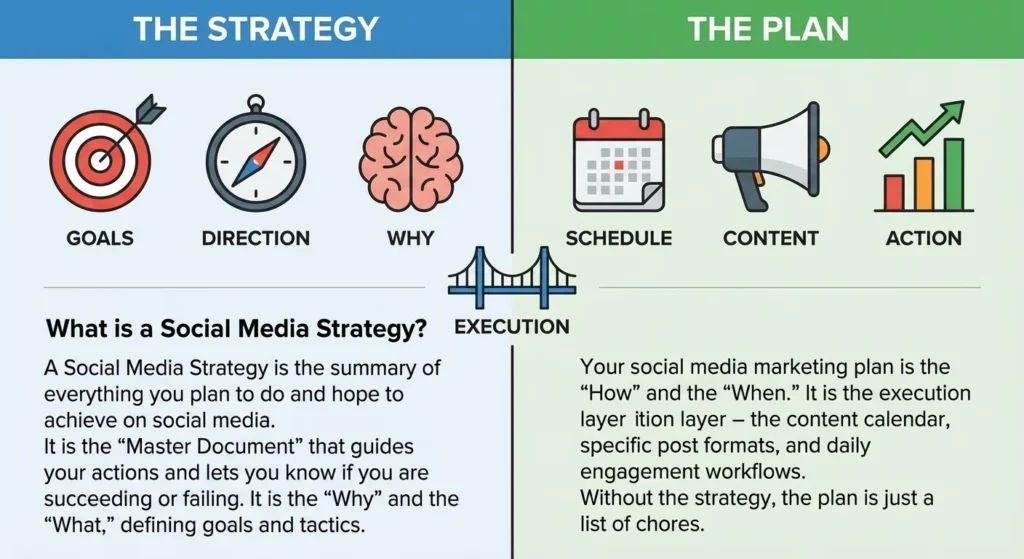
A Social Media Strategy is the summary of everything you plan to do and hope to achieve on social media. It is the “Master Document” that guides your actions and lets you know if you are succeeding or failing.
It is crucial to distinguish between a strategy and a plan, as they are often confused. Your strategy is the “Why” and the “What.”
It defines your goals and the tactics you will use to achieve them. For example, a strategy statement might be: “We will use LinkedIn to position our CEO as a thought leader to attract Enterprise-level clients.”
Your social media marketing plan, on the other hand, is the “How” and the “When.” It is the execution layer – the content calendar, the specific post formats, and the daily engagement workflows. Without the strategy, the plan is just a list of chores. Without the plan, the strategy is just a dream.
The Core Framework: The 7 C’s of Social Media Strategy
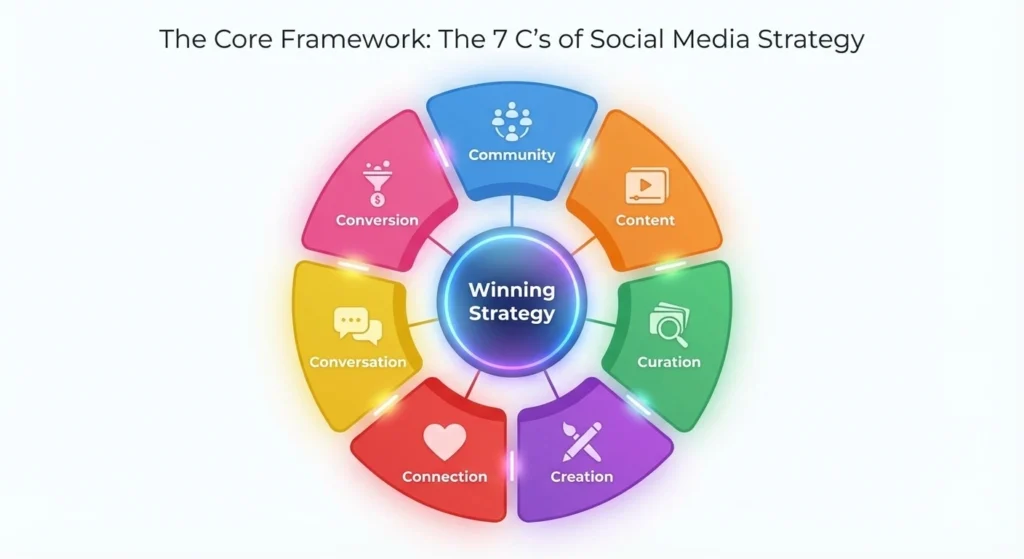
To build a holistic community rather than just a broadcasting channel, your strategy must address the seven fundamental elements of social interaction. These “7 C’s” ensure your social media campaign is balanced and human-centric.
1. Community
This is the bedrock of your strategy. You are not building an audience; you are building a community. An audience listens, but a community interacts with each other.
Your strategy must define who these people are and what brings them together. Is it a shared pain point? A shared passion? If you cannot define the common thread that binds your followers, you cannot lead them.
2. Content
Content is the currency of social media. This pillar defines what value you are actually providing in exchange for your user’s time.
In 2026, content must be “edutainment” – a blend of education and entertainment. Your strategy needs to map out exactly what formats (video, text, image) and topics will resonate most with your specific community.
3. Curation
You do not always have to be the creator. A smart strategy involves curation – sharing relevant insights, news, and content from other thought leaders in your industry.
This positions your brand not just as a narcissist talking about itself, but as a helpful resource that filters the noise for your followers. It builds trust because it shows you care about their knowledge, not just your sales.
4. Creation
While curation is useful, creation is mandatory. This refers to the original, branded assets you produce that carry your unique voice and visual identity.
This is where you differentiate yourself from competitors. Your creative output must be consistent, high-quality, and unmistakably “you” to cut through the feed.
5. Connection
Social media is ultimately about relationships. The “Connection” pillar focuses on the emotional link between brand and buyer. How does your brand make people feel?
Does your content inspire hope, alleviate fear, or provide a sense of belonging? We buy from brands we feel connected to, and your strategy must explicitly define the emotional tone you wish to convey.
6. Conversation
This is often the most neglected C. Many brands treat social media as a megaphone, broadcasting messages without listening.
A winning strategy prioritizes two-way dialogue. It mandates that you ask questions, reply to comments, and actively participate in discussions. The algorithm rewards conversation, and so do customers.
7. Conversion
Finally, all this activity must lead somewhere. Conversion is the art of turning engagement into business results.
Whether it is a newsletter signup, a product purchase, or a demo request, your strategy must include clear pathways for a follower to become a customer. Without conversion, you have a hobby, not a business.
The 5 P’s of Social Media Marketing
Adapted from the classic Marketing Mix, the 5 P’s ensure your social media efforts are commercially viable and aligned with business reality.
1. Product
On social media, your “product” is twofold. First, there is the actual product or service you sell. Second, and perhaps more importantly for the algorithm, your content is a product.
You must treat every post as a standalone product that needs to be high-quality and valuable enough to “sell” itself to the viewer in exchange for their attention.
2. Price
In the context of social media, price is rarely about money – it is about time and attention. Your audience pays you with their focus.
If your content (the product) is not worth the 30 seconds of attention (the price) they spend watching it, they will scroll past. Your strategy must ensure the value proposition is always in the user’s favor.
3. Place
“Place” refers to platform selection. You cannot be everywhere at once. A critical strategic decision is choosing where your “shop” is located.
Is your audience hanging out on the professional streets of LinkedIn, the visual galleries of Instagram, or the fast-paced newsroom of X (Twitter)? Choosing the wrong place for your message is a guaranteed way to fail.
4. Promotion
How will people find your content? Promotion includes both organic distribution (hashtags, SEO, timing) and paid amplification (boosted posts, ads).
A modern strategy accepts that “build it and they will come” is a myth. You must actively promote your presence, perhaps even using Social Media Growth services to jumpstart your visibility in a crowded marketplace.
5. People
This P covers the human element on both sides of the screen. Who is managing the account? Do they have the right tone and training?
And on the other side, who exactly is the audience? Understanding the psychology of the “People” involved is what separates a robotic corporate account from a beloved brand voice.
How to Create a Social Media Strategy in 8 Steps
Now that you understand the framework, it is time to build the machine. This 8-step process moves linearly; skipping a step is often the reason strategies fail.
Step 1: Set S.M.A.R.T. Goals
Most businesses fail here because their goals are vague. “We want to go viral” is not a strategy; it is a wish. “We want more followers” is vanity. To drive revenue, your goals must be S.M.A.R.T.: Specific, Measurable, Achievable, Relevant, and Time-bound.
Looking For Google Reviews? Claim your Discount Below
 8,492 people used this service in the past 7 days

You must also distinguish between Vanity Metrics and Business Metrics:
- Vanity Metrics: Likes, Followers, Views. (These feel good but don’t pay bills).
- Business Metrics: Click-through rate (CTR), Conversion Rate, Cost Per Lead (CPL). (These drive growth).
Example of a S.M.A.R.T. Goal: “We will increase Instagram engagement by 20% in Q1 2026 to drive 500 qualified clicks to our ‘Book a Demo’ page.”
Step 2: Audit Your Current Presence
Before you map out where you are going, you must know where you are. You cannot build a new social media marketing plan on a rotten foundation.
The “Incognito” Test: Open a private browser window and search your brand name. What appears?
- Visuals: Do your headers and profile pictures match your current branding, or are they from three years ago?
- Activity: Does the account look “lived in”? An account with the last post from 2023 signals to customers that you are out of business.
- Sentiment: Are people praising you or complaining? If you find unresolved negative reviews or angry comments, you may have a reputation leak. (If the sentiment is overwhelmingly negative, you may need to pause and focus on Online Reputation Repair before aggressively marketing).
The SWOT Analysis:
- Strengths: What are you doing well? (e.g., “Our video content gets high views”).
- Weaknesses: Where are you failing? (e.g., “We never reply to comments”).
- Opportunities: Is there a new trend or platform you are missing?
- Threats: What are competitors doing better than you?
Step 3: Define Your Target Audience (The “Who”)
If you try to speak to everyone, you speak to no one. A winning strategy requires deep specificity. You need to move beyond basic demographics (Age: 25-40) and understand Psychographics.
Create distinct User Personas for your audience:
- The “Pain” Persona: What keeps them up at night? (e.g., “Marketing Manager Mike is stressed because his CPA is too high”).
- The “Passion” Persona: What do they love? (e.g., “Fitness Fiona loves data-driven workout tracking”).
The 80/20 Audience Rule: Identify who your “Whales” are. Often, 20% of your audience provides 80% of your revenue. Your content strategy should be laser-focused on delighting that top 20%, rather than trying to mildly please the bottom 80%.
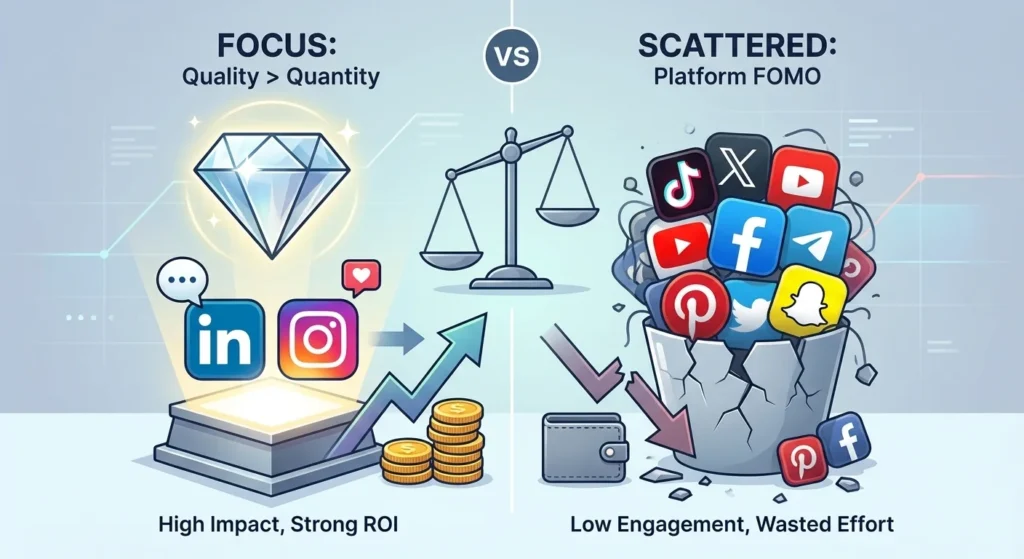
Step 4: Choose Your Platforms (Quality > Quantity)
A common mistake is “Platform FOMO.” It is better to have an amazing presence on one platform than a mediocre presence on five. Base your choice on data from sources like Pew Research Center, not just trends.
- LinkedIn: The non-negotiable hub for B2B. High organic reach for text and personal stories. Best for: Thought leadership, lead gen, and recruiting.
- Instagram: The visual storefront. Essential for B2C brands. Best for: Brand awareness, product showcasing, and community building via Stories.
- TikTok / YouTube Shorts: The engine of virality. If you want massive reach quickly, short-form video is the only path. Best for: Reaching Gen Z, “edutainment,” and behind-the-scenes authenticity.
- X (Twitter): The town square. Best for: Real-time customer service, news updates, and connecting with journalists.
Step 5: Develop Your Content Strategy (The “What”)
This is the heart of your social media marketing plan. Without clear themes, your feed becomes a confusing mess of random thoughts. You need Content Pillars.
The Content Pillar Framework: Choose 3–5 core themes that you will rotate. For a B2B SaaS company, these might be:
- Educational: “How-to” guides and industry tips (Builds Authority).
- Culture: Behind-the-scenes at the office (Builds Trust).
- Social Proof: Case studies and client wins (Builds Confidence).
- Promotional: Product updates and offers (Drives Sales).
The 80/20 Content Rule: A winning strategy follows the Pareto Principle: 80% of your content should educate, entertain, or inspire. Only 20% should actively sell your product. If you ask for the sale in every post, you will burn out your audience.
The Calendar: Consistency is more important than intensity. Use a content calendar (Trello, Notion, or Asana) to plan one month ahead. This prevents the “What do I post today?” panic that leads to low-quality content.
Step 6: The “Growth Engine” (Distribution & Catalyst)
This is the step most strategies miss. In 2026, organic reach is at an all-time low. You can create the best content in the world, but if the algorithm doesn’t show it to anyone, your strategy fails.
You cannot rely on “hope marketing.” You need a Growth Catalyst.
- The Catalyst Strategy: Algorithms favor accounts that already have momentum. To break through the noise, you often need to jumpstart your engagement.
- Active Growth: Utilizing Social Media Growth services provides the initial “social proof” (followers and likes) needed to signal to the algorithm that your content is valuable. This prevents your account from looking like a “ghost town” to new visitors.
- Deep Dive: There are specific tactics to maximize this catalytic effect. For a detailed breakdown, read our guide on [10 Proven Social Media Growth Strategies That Actually Work].
Step 7: Engagement & Community Management
Social media is a two-way street, not a billboard. A social media strategy template that lacks an engagement protocol is incomplete.
The “Golden Hour” Rule: The first 60 minutes after posting are critical. If you receive comments, reply immediately. This activity signals to the platform that your post is sparking conversation, prompting the algorithm to push it to a wider audience.
The Trust Factor: Engagement is where sales happen. A like is a vanity metric; a comment is a lead. Treat every comment as a customer service ticket. If you ignore them, you are effectively hanging up the phone on a potential client.
Step 8: Measure, Analyze, and Pivot
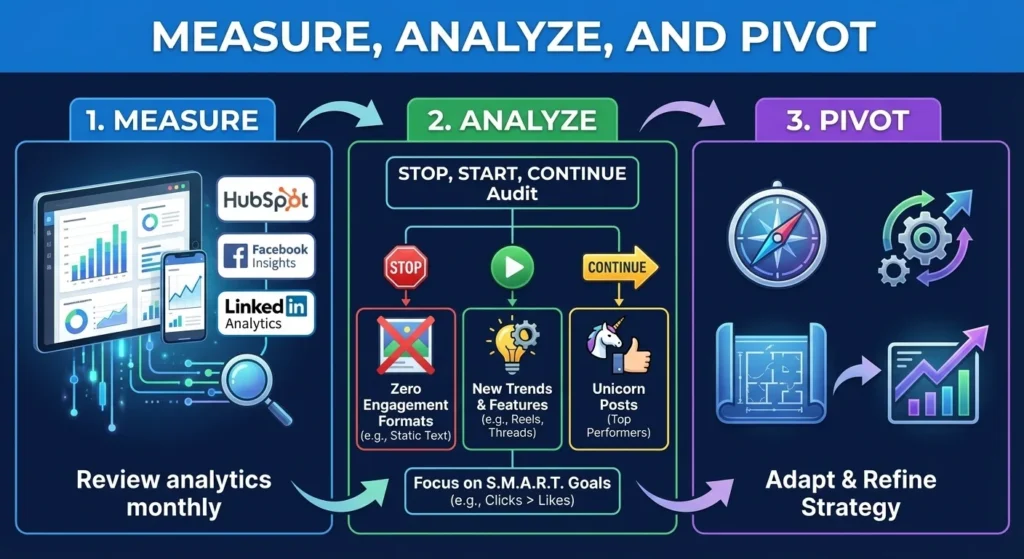
A strategy is a living document. Use tools like HubSpot or native insights to review your analytics monthly.
The “Stop, Start, Continue” Audit: Every month, look at your data and ask:
- Stop: What post format got zero engagement? (Stop wasting time on it).
- Start: What new trend or platform feature (e.g., Reels, Threads) should we test?
- Continue: Which post was the “Unicorn” (top performer)? How can we make more of that?
Tools of the Trade: Use native insights (Facebook Insights, LinkedIn Analytics) or third-party tools (Buffer, Sprout Social) to track your S.M.A.R.T. goals. If your goal was “Clicks,” do not get distracted by “Likes.”
Execution: DIY vs. Agency
Once your strategy is documented, the hardest question remains: Who is going to do all this work?
You have two primary paths, each with distinct trade-offs.
1. The DIY Route (In-House) This involves you or your internal team handling all content creation, posting, and engagement.
- Pros: Total control over your brand voice; lower direct costs; faster reaction to internal news.
- Cons: Extremely time-consuming. It is difficult to scale without hiring a dedicated team, and burnout is common.
2. The Agency Route This involves hiring a professional team to manage the strategy for you.
- Pros: Consistent execution; access to expert tools and design; scalability.
- Cons: Higher monthly retainer; requires clear communication to ensure they capture your brand voice.
The Hybrid Approach: Many successful brands choose a middle ground. They keep the strategy and engagement in-house (to stay authentic) but outsource the heavy lifting – like graphic design and Social Media Growth – to partners who can deliver results at scale.
If you are unsure which path is right for your current stage of business, read our detailed comparison: [DIY vs. Agency: Do You Need a Social Media Management Service?].
Conclusion
A social media strategy is not just a calendar of posts; it is a commitment to your audience. It turns your brand from a passive participant into an active industry leader.
In 2026, the brands that win are not the ones who post the most, but the ones who plan the best. They audit their presence, define their audience with precision, and fuel their profiles with strategic authority.
By following this roadmap – setting S.M.A.R.T. goals, creating valuable content, and using a catalyst like Social Media Growth – you build an asset that drives revenue long after the “publish” button is pressed.
Don’t just post. Plan.
Frequently Asked Questions (FAQ)
What are the 7 C’s of social media strategy?
To build a sustainable ecosystem, a strategy must balance these seven elements:
- Community: The people you bring together.
- Content: The value you provide.
- Curation: Sharing others’ insights to build trust.
- Creation: Your original, branded assets.
- Connection: The emotional bond with the audience.
- Conversation: Two-way dialogue (replies/DMs).
- Conversion: Turning engagement into revenue.
What are the 5 P’s of social media?
Adapted from the marketing mix, these are: Product (your content), Price (time/attention), Place (platform selection), Promotion (distribution), and People (your team and audience). Addressing all five ensures your social strategy aligns with your business goals.
What is the golden rule of social media strategy?
The golden rule is the 80/20 Rule: 80% of your content should serve the audience (educate, entertain, inspire), and only 20% should serve your business (promote, sell). If you violate this ratio, you lose the audience’s attention, and your sales messages will be ignored.
How much does a social media strategy cost?
The cost varies wildly based on execution. A DIY approach costs only your time and tool subscriptions (approx. $50-$200/month). Hiring a freelancer might cost $1,000-$3,000/month. A full-service agency typically charges $3,000-$10,000+ per month depending on the volume of content and platforms managed.