See 15 Powerful Social Proof Examples to Boost Brand Credibility
Social proof is one of the most effective ways to influence consumer behavior because people naturally look to others when making a decision.
Using social proof examples throughout your marketing funnel can turn a skeptical browser into a confident buyer by demonstrating that your brand is already trusted by their peers.
When a potential customer visits your website or social media profile, they are looking for reassurance. They want to know that your product works, that your service is reliable, and that they won’t regret their purchase.
By strategically placing evidence of happy customers and industry recognition, you build a foundation of brand credibility that traditional advertising simply cannot match.
In this guide, we will explore 15 powerful ways to use social validation to grow your business, increase your conversion rates, and strengthen your online reputation.
Current data for 2026 shows that nearly 95% of consumers read online reviews before committing to a purchase.
Table of Contents
The Psychology of Social Proof and Brand Credibility
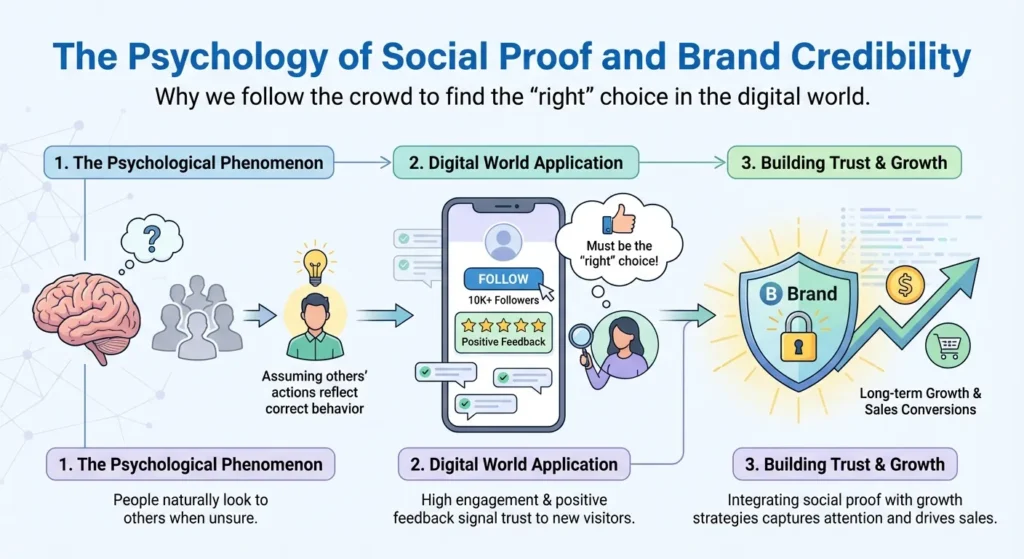
Social proof works because of a psychological phenomenon where people assume the actions of others reflect correct behavior for a given situation.
In the digital world, this means if thousands of people are following a brand or leaving positive feedback, new visitors assume that brand is the “right” choice.
Building this trust is essential for long-term growth. If you are looking to scale your presence quickly, integrating these examples with proven social media growth strategies allows you to capture attention and convert it into sales.
15 Powerful Social Proof Examples
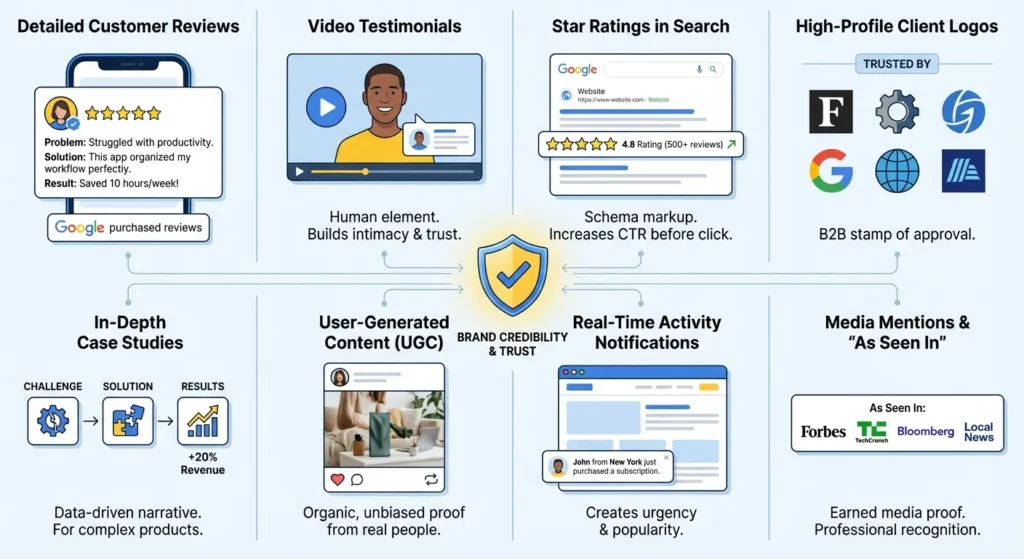
While the concept of social validation is simple, the execution varies depending on your platform and your audience’s needs.
Some customers want the hard data of a case study, while others are moved by the visual energy of a customer’s Instagram post. Below, we have broken down 15 high-impact examples into categories to help you identify which will most effectively build your brand credibility.
1. Detailed Customer Reviews
Standard reviews are the bread and butter of social proof. However, detailed reviews that mention specific problems and how your product solved them are far more persuasive than a simple “Great product!” comment.
To maximize this impact, many businesses choose to buy Google reviews from reputable sources to ensure their profile reflects the high quality of their service from the start. Having a steady stream of positive feedback on Google is often the first thing a customer sees when searching for your brand.
2. Video Testimonials
A video of a real person talking about their experience is incredibly difficult to fake. It adds a human element to your brand. Seeing a customer’s facial expressions and hearing their tone of voice builds a level of intimacy and trust that text alone cannot achieve.
3. Star Ratings on Search Results
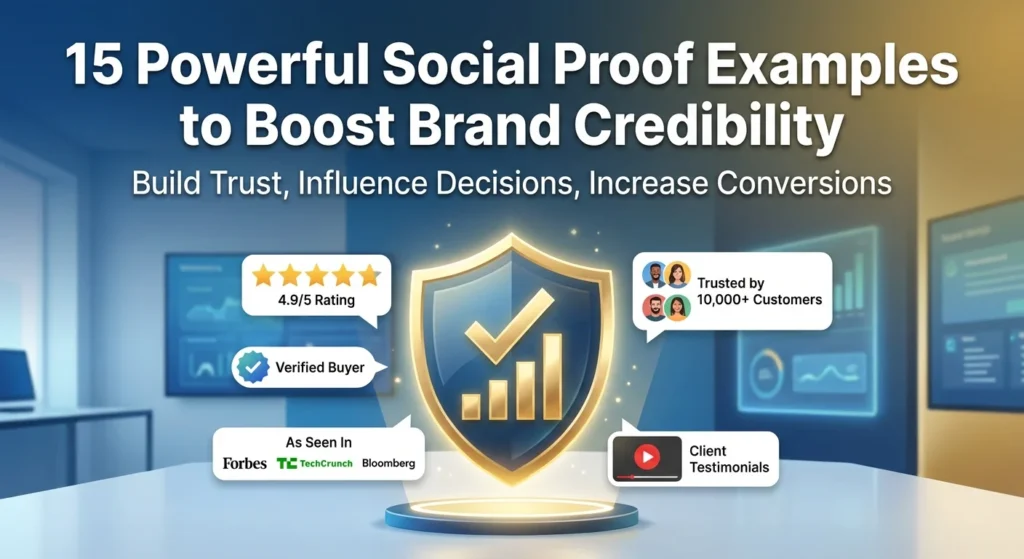
Using schema markup to display star ratings directly in Google search results (SERPs) can significantly increase your click-through rate. When your link has a 4.8-star rating visible before the user even clicks, you have already won half the battle of establishing credibility.
4. High-Profile Client Logos
If you provide B2B services, displaying the logos of well-known companies you have worked with acts as a massive “stamp of approval.” If a major corporation trusts you, a small business or individual consumer will likely feel safe doing the same.
5. In-Depth Case Studies
For complex products or high-ticket services, a case study is the ultimate form of proof. It provides a data-driven narrative: the challenge the client faced, the solution you provided, and the measurable results (like a 20% increase in revenue). This is a staple for any professional brand reputation strategy.
6. User-Generated Content (UGC)
When customers post photos or videos of your product on their own social media, it serves as organic, unbiased proof. Reposting this content on your official channels (with permission) shows that real people are enjoying your brand in their daily lives.
7. Real-Time Activity Notifications
You have likely seen small pop-ups on websites saying, “John from New York just purchased a subscription.” These notifications create a sense of urgency and popularity, proving that your site is active and people are currently buying.
8. Media Mentions and “As Seen In” Bars
Being featured in reputable news outlets like Forbes, TechCrunch, or local news provides “earned” media proof. This tells the customer that your brand is significant enough to be noticed by professional journalists and editors.
Looking For Google Reviews? Claim your Discount Below
 8,492 people used this service in the past 7 days

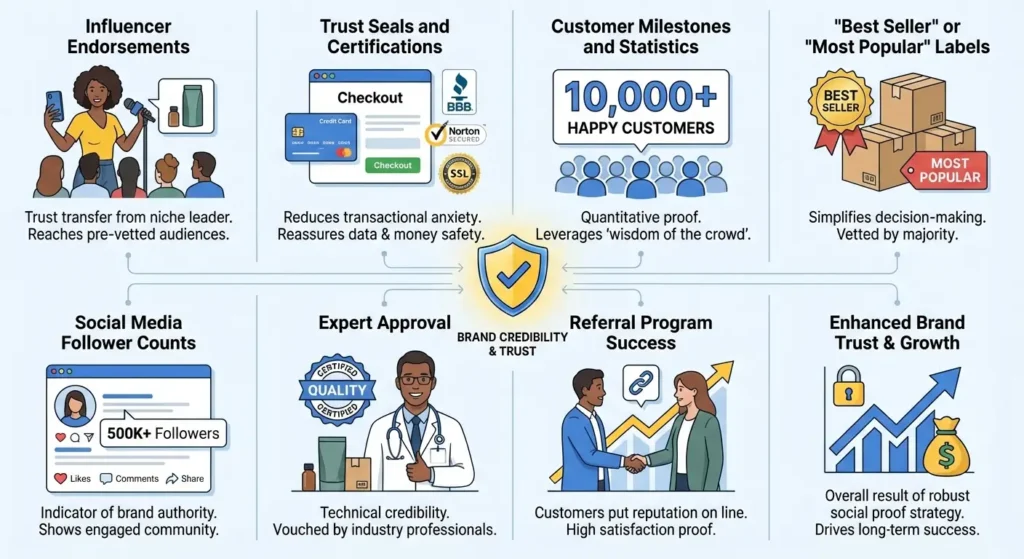
9. Influencer Endorsements
When an influencer in your niche recommends your product, their followers transfer the trust they have in the influencer to your brand. This is a highly effective way to fuel social media growth by reaching pre-vetted audiences.
10. Trust Seals and Certifications
Displaying badges from organizations like the Better Business Bureau (BBB) or security certifications like Norton Secured helps reduce “transactional anxiety.” It reassures the customer that their data and money are safe with you.
11. Customer Milestones and Statistics
Numbers are hard to argue with. Phrases like “Over 10,000 happy customers” or “Used by 500+ agencies worldwide” provide a quantitative look at your brand’s success. It leverages the “wisdom of the crowd” to make the user feel like they are joining a winning team.
12. “Best Seller” or “Most Popular” Labels
By highlighting a specific product as a top seller, you make the decision-making process easier for the customer. Most people are comfortable choosing the option that the majority of others have already vetted.
13. Social Media Follower Counts
While sometimes dismissed as a vanity metric, a large, engaged following is a clear indicator of brand authority. It shows that you have a community that values your content. High engagement levels are a key metric when you measure social media engagement to see how well your content is resonating.
14. Expert Approval
Having an industry expert or a certified professional (like a doctor for a supplement or an engineer for a tool) vouch for your product adds technical credibility. It moves the conversation from “I like this” to “This is objectively high quality.”
15. Referral Program Success
When you can show that a large percentage of your new customers come from referrals, it proves that your existing customers are so satisfied they are willing to put their own reputation on the line to recommend you to friends.
Common Social Proof Mistakes to Avoid
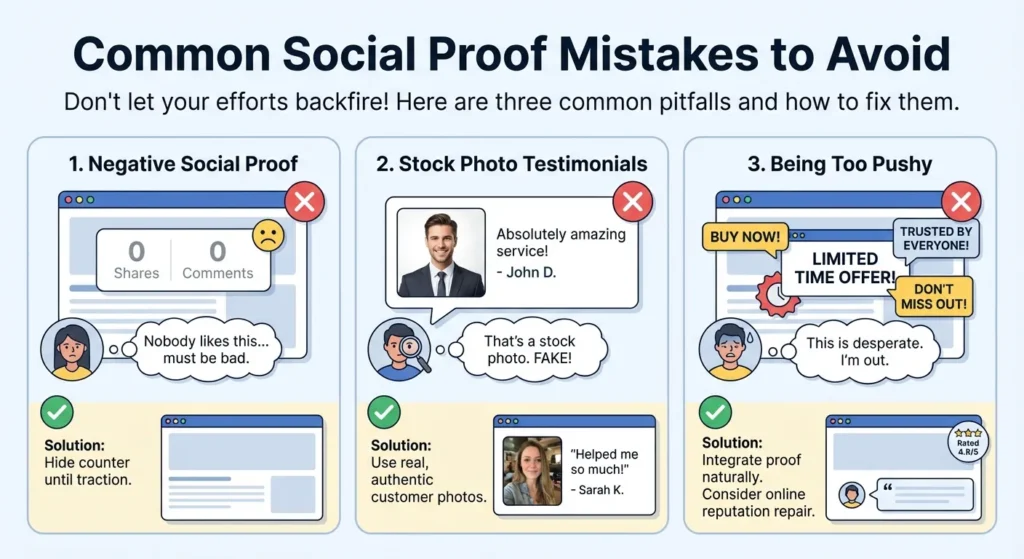
Even with the best intentions, social proof can backfire if handled incorrectly. One of the biggest mistakes is negative social proof.
For example, showing a social sharing counter that says “0 shares” actually tells the user that your content isn’t worth sharing. If your numbers are low, it is better to hide the counter until you have built up more traction.
Another error is using stock photos for testimonials. Customers are very good at spotting generic photography. Using a real photo of a customer, even if it isn’t “magazine quality” is always more effective because it is authentic.
Lastly, avoid being too pushy. Social proof should feel like a natural part of the browsing experience, not a desperate attempt to prove you are legitimate.
If you are struggling with a few bad marks on your record, you might need an online reputation repair guide to clean up your image before scaling your proof efforts.
Integrating Social Proof into Your Strategy
To truly boost your brand credibility, social proof should be integrated into every stage of your customer’s journey.
- Awareness: Use media logos and influencer mentions in your ads.
- Consideration: Feature detailed case studies and expert endorsements on your service pages.
- Decision: Place star ratings and “Secure Checkout” badges right where the user clicks “Buy.”
If you are just starting out and your Google Business Profile looks a bit empty, it can be difficult to get that initial momentum.
This is where you can buy Google reviews from to give your brand the professional appearance it deserves. Once you have that baseline of trust, organic reviews and social media engagement will follow much more easily.
Managing your brand is a constant process of monitoring how the world perceives you. For a deeper look at how to maintain this balance, refer to our social media reputation management guide to ensure your brand remains a trusted leader in your industry.
Frequently Asked Questions
What is an example of social proof?
A common example is a “Testimonials” section on a website. When a software company displays quotes from users explaining how the tool saved them five hours a week, that is social proof. In the physical world, a long line outside a nightclub is a form of social proof that tells passersby the venue is popular.
What are some social proof mistakes to avoid?
- Outdated Proof: A testimonial from five years ago might suggest your business is no longer active or relevant.
- Lack of Specificity: Generic praise like “Good service” is much weaker than “The support team answered my call in 30 seconds and fixed my issue immediately.”
What is another term for social proof?
Social proof is often referred to as informational social influence. In marketing circles, it is also frequently called social validation or herd mentality, though marketers prefer the former as it sounds more professional.
Is social proof legit?
Yes, social proof is a legitimate and scientifically studied psychological principle. It is based on the human instinct to seek safety in numbers.
As long as the evidence you provide,such as reviews, logos, and data, is honest and accurate, it is one of the most ethical ways to build a business relationship.