DIY vs. Agency: Do You Need a Social Media Management Service?
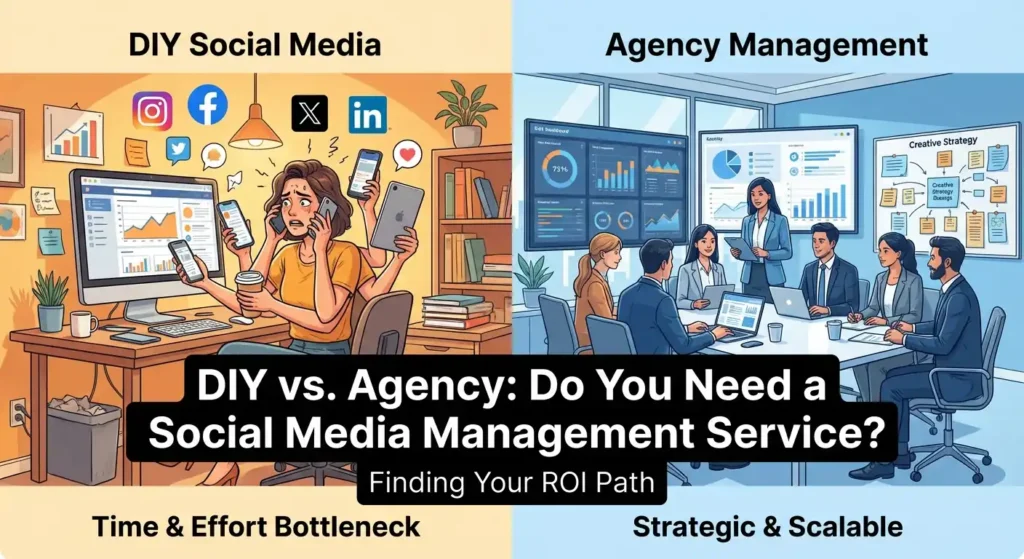
Social Media Management is no longer just about posting a photo when you have a spare moment. It has evolved into a 24-hour operation that demands strategy, creativity, and constant engagement.
For many business owners, this reality creates a difficult bottleneck. You know you need an active presence to grow, but you likely lack the hours in the day to execute it effectively.
This leaves you with a critical decision: Do you try to handle it all yourself (or assign it to an existing employee), or do you hire a professional Social Media Management Service?
This guide breaks down the true scope of the work, the hidden costs of doing it yourself, and how to decide which path will actually provide a return on your investment.
Table of Contents
What Does Professional Social Media Management Actually Entail?
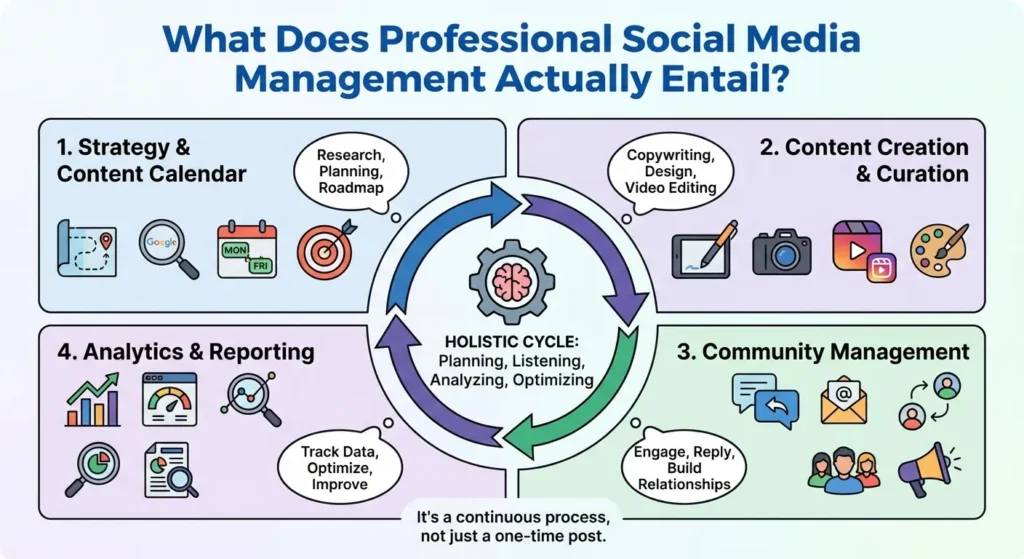
Before you can decide who should do the job, you need to understand what the job actually is. Many people mistake “social media management” for “social media posting.” There is a massive difference between the two.
Posting is simply uploading content. Management is a holistic cycle that involves planning, listening, analyzing, and optimizing.
If you treat it only as posting, you will likely see zero growth. A true management strategy includes several heavy-lifting pillars that must be maintained simultaneously.
1. Strategy and Content Calendar
You cannot post randomly and expect results. You need a roadmap that aligns with your business goals.
This involves researching what your competitors are doing and identifying gaps in the market. You need to know exactly what is going out on Monday morning versus Friday afternoon.
2. Content Creation and Curation
This is often the most time-consuming part. It involves:
- Copywriting: Writing captions that hook the reader immediately.
- Graphic Design: Creating on-brand visuals that stop the scroll.
- Video Editing: Producing Reels or TikToks, which are currently the biggest drivers of organic reach.
If you are doing this yourself, you are acting as a writer, designer, and video editor all at once.
3. Community Management
Social media is a two-way street. If you post content but ignore the comments, the platforms will punish your reach. You must engage with your audience.
This means replying to comments, answering direct messages, and even commenting on potential customers’ posts to build awareness.
In fact, recent data shows that replying to comments can boost your post engagement by up to 42%, signaling to algorithms that your content is valuable
4. Analytics and Reporting
How do you know if your efforts are working? You need to track data points beyond just “likes.” You need to look at engagement rates, click-through rates, and conversion data. If you aren’t measuring it, you can’t improve it.
Option 1: The DIY Route (In-House Management)
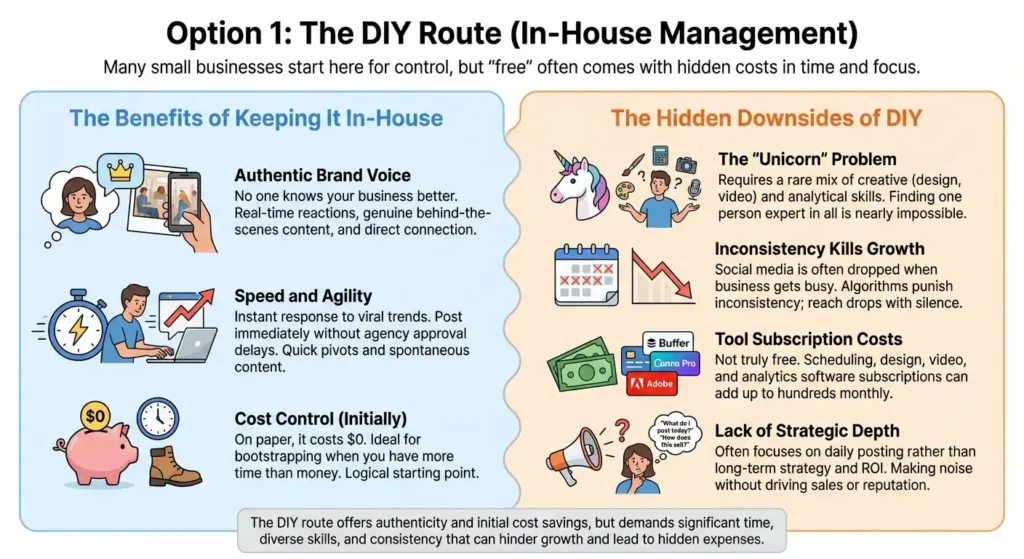
Many small businesses start here. It feels like the safer option because it doesn’t require signing a contract with an external firm. However, “free” often comes with a significant cost in time and focus.
The Benefits of Keeping It In-House
Authentic Brand Voice. No one knows your business better than you do. When you manage your own social media, the voice is authentic.
You can instantly capture behind-the-scenes moments or react to office events in real-time. An agency will always have a slight delay in approval processes.
Speed and Agility. If a trend goes viral on Tuesday morning, an in-house person can film and post a reaction by Tuesday lunch. Agencies often work on monthly calendars, so injecting spontaneous contentcan sometimes be slower.
Cost Control (Initially) On paper, doing it yourself costs $0. If you are bootstrapping and have more time than money, this is the logical place to start.
The Hidden Downsides of DIY
The “Unicorn” Problem. Effective social media management requires a mix of left-brain and right-brain skills. You need the creativity to design graphics and the analytical mind to read data spreadsheets.
Finding one person who is an expert at writing, design, video editing, and data analysis is nearly impossible. Usually, you end up with someone who is good at one thing and ignores the others.
Inconsistency Kills Growth. When business gets busy, social media is usually the first task to get dropped. You might post every day for a week, then go silent for a month because you had a client project to finish.
Algorithms hate inconsistency. If you stop feeding the machine, your reach drops to zero, and you have to start over.
Tool Subscription Costs: You might save on agency fees, but you will still need to pay for software to do the job right. You will likely need:
- Scheduling tools (e.g., Buffer, Hootsuite)
- Design software (e.g., Canva Pro, Adobe Creative Cloud)
- Stock video or photo subscriptions
- Analytics tools
These monthly subscriptions can easily add up to hundreds of dollars a month, eating into your “savings.”
Lack of Strategic Depth Most DIY managers focus on “what do I post today?” rather than “how does this post lead to a sale?”
Without a high-level strategy, you are just making noise. You need to understand how social signals feed into your broader reputation.
Option 2: Hiring a Social Media Management Service (Agency)
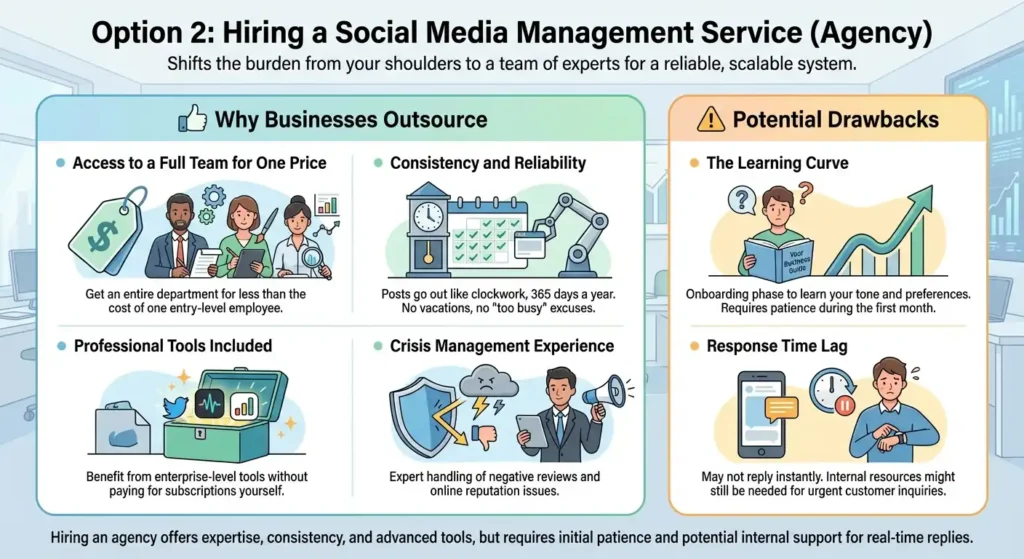
Hiring an agency or a dedicated service provider shifts the burden from your shoulders to a team of experts. This is the model used by most scaling businesses because it turns social media into a reliable system rather than a daily chore.
Looking For Google Reviews? Claim your Discount Below
 8,492 people used this service in the past 7 days

Why Businesses Outsource
Access to a Full Team for One Price. When you hire an agency, you aren’t just hiring a social media manager. You are typically getting access to a strategist, a copywriter, a designer, and a data analyst. You get an entire department for less than the cost of one entry-level employee.
Consistency and Reliability. Agencies don’t get “too busy” to post. They don’t go on vacation and leave your account empty. They use professional scheduling software to ensure your content goes out like clockwork, 365 days a year. This consistency is the single biggest factor in long-term growth.
Professional Tools Included. Agencies already pay for enterprise-level tools for listening, scheduling, and reporting. You benefit from these expensive tools without having to pay for the subscriptions yourself.
Crisis Management Experience. What happens if you get a negative review or a PR issue? Agencies have experience handling online reputation issues. They know how to respond to negativity without making it worse.
Potential Drawbacks
The Learning Curve. No external team will understand your business as well as you do on day one. There is always an onboarding phase where the agency learns your tone of voice and preferences. You have to be patient during the first month.
Response Time Lag. While agencies are great at posting, they may not be able to reply to a specific customer question within 5 minutes. You may still need someone internally to handle urgent customer service inquiries that come through DMs.
The Cost Breakdown: Salary vs. Retainer
Let’s look at the numbers. Many business owners assume an agency is expensive, but let’s compare it to the cost of a full-time in-house hire.
In-House Social Media Manager:
- Average Salary: $50,000 – $65,000 per year (depending on location).
- Overhead: Taxes, health benefits, paid time off, equipment (laptop, phone).
- Software: ~$3,000 per year.
- Total Annual Cost: $70,000+
Social Media Management Service:
- Monthly Retainer: Typically $1,000 – $4,000 per month (depending on the number of platforms and posts).
- Overhead: $0.
- Software: $0 (Included).
- Total Annual Cost: $12,000 – $48,000
The Verdict: For most small to mid-sized businesses, an agency is significantly cheaper than hiring a full-time employee.
You would only save money with DIY if you do it yourself—but you must calculate the cost of your own time. If your hourly rate as a business owner is $100/hour, and you spend 10 hours a week on social media, you are “spending” $4,000 a month of your own time.
The Hybrid Model: The Best of Both Worlds?
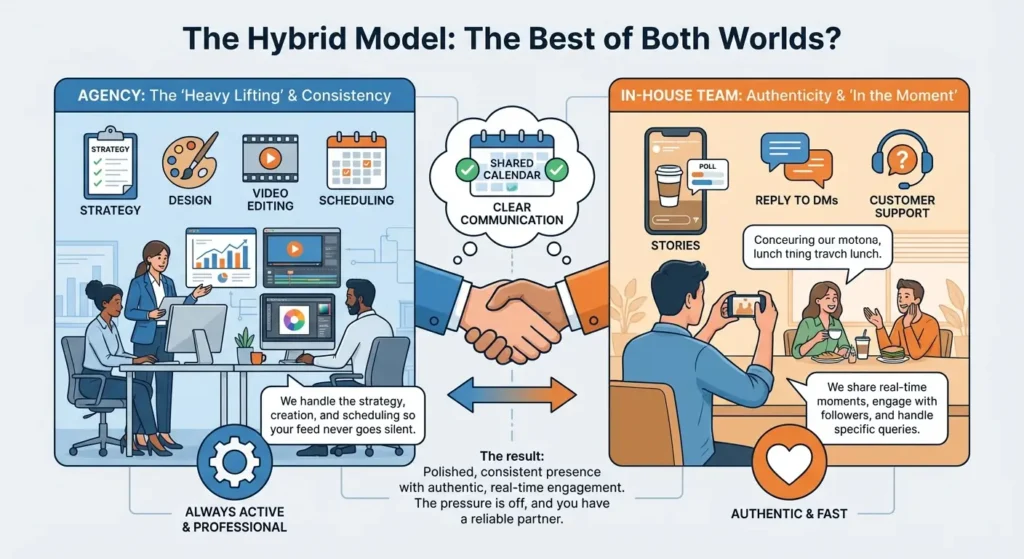
You don’t always have to choose one or the other. Many successful brands use a Hybrid Model.
In this scenario, you hire an agency to handle the “heavy lifting.” They create the strategy, design the graphics, edit the videos, and manage the scheduling. They ensure the account is always active and professional.
Meanwhile, you or your team handle the “in the moment” stuff. You post Instagram Stories of the team having lunch, you reply to DMs, and you handle specific customer support issues.
This gives you the polish and consistency of an agency, combined with the authenticity and speed of an in-house team.
It also takes the pressure off. You can post when you feel inspired, knowing that even if you have a busy week, the agency has your back and the feed won’t go silent.
For this to work, you need clear communication. Most agencies use shared calendars where you can see what they are planning and approve it before it goes live.
Conclusion
Your digital reputation is one of your most valuable assets. Whether you choose to manage it yourself or hire a professional Social Media Management Service, the most important thing is that you treat it with respect.
Inconsistent, low-quality posting can actually hurt your brand more than having no presence at all. It signals to customers that you are disorganized or out of business.
If you decide to outsource, look for a partner that focuses on metrics that matter—growth, engagement, and reputation.
And remember, a great social strategy works best when it is backed by a solid reputation. If your review profile is thin, consider bolstering it with our services to ensure your new social traffic converts into paying customers.
Frequently Asked Questions
What is the difference between a social media manager and a community manager?
A social media manager focuses on the content and the strategy. They plan the calendar, create the posts, and analyze the data to see what is working. A community manager focuses on the people.
Their main job is to reply to comments, foster discussions, and build relationships with the audience. In smaller teams, these roles are often combined, but as you grow, they usually become separate jobs.
Can I delete bad reviews on Google?
Technically, you cannot simply hit “delete” on a Google review just because you don’t like it. Google only removes reviews that violate their specific content policies (like spam or hate speech).
However, there are strategies to manage and mitigate the impact of negative reviews.
How long does it take to see results from a management service?
Social media is a marathon, not a sprint. While paid ads can generate immediate traffic, organic social media management typically takes 3 to 6 months to show significant momentum.
The first month is usually spent on strategy and audit, the second on implementation, and by the third month, the consistency starts to compound into increased engagement and reach.
Do I need to give the agency my passwords?
Yes, but you should do it securely. Most professional agencies use tools that allow you to connect your accounts without sharing the raw password in a text file.
Alternatively, platforms like Facebook and LinkedIn allow you to grant “Partner” or “Admin” access to the agency’s business account, which is the safest way to manage permissions.